Laptop sticker advertising: how brands buy laptop lid ad space
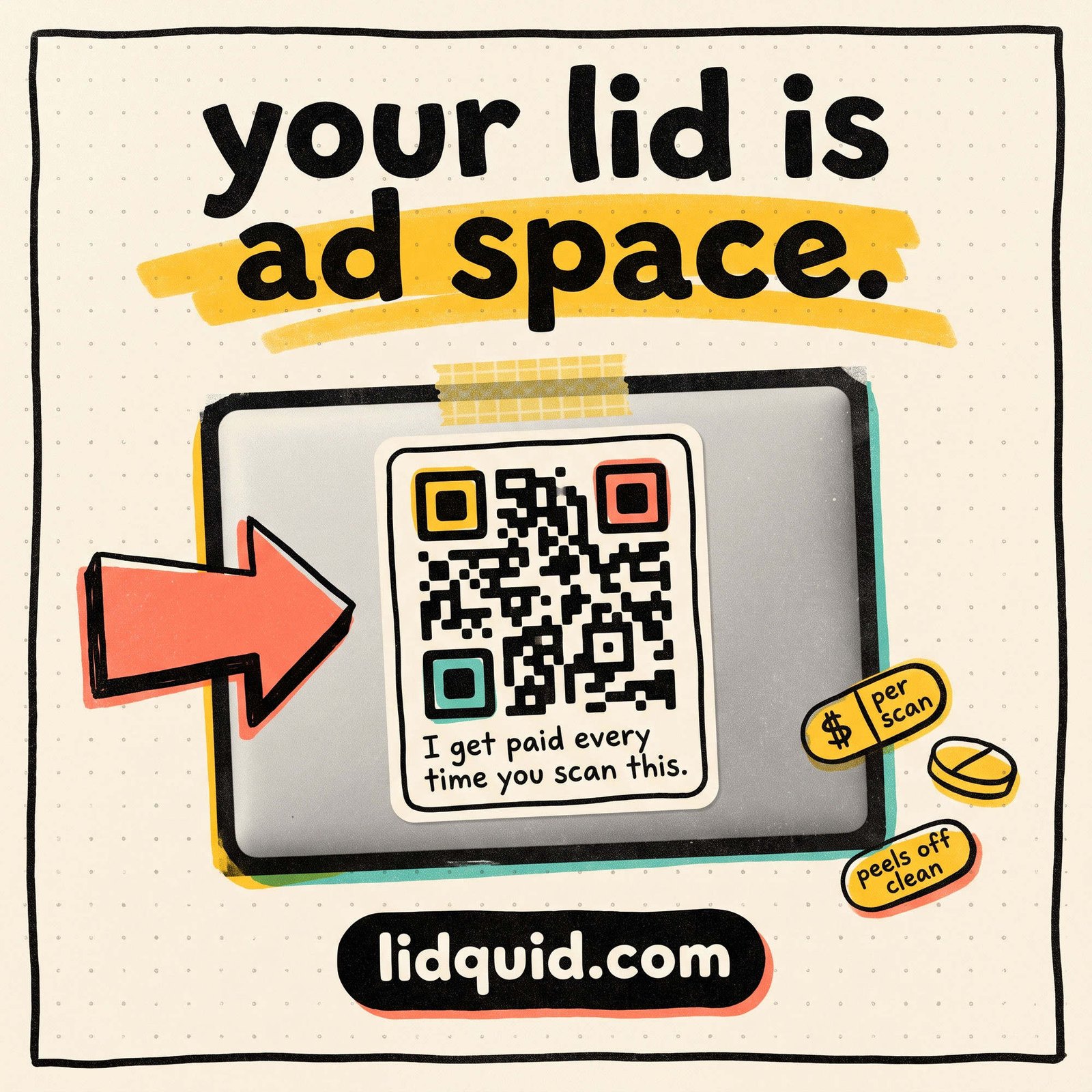
Laptop sticker advertising puts your brand's QR sticker on the back of real people's laptops, in the cafés, libraries, campuses and coworking spaces where your audience already sits. With Lidquid, owners opt in and approve your brand, and you pay only for verified scans, not impressions.
- Reach: students, remote workers and coworking regulars, at eye level, for hours.
- Pricing: per city and per verified scan.
- Reporting: raw and billable scans side by side.
What is laptop sticker advertising?
It's a form of out-of-home advertising where the "billboard" is the lid of an open laptop. A sponsored sticker with a QR code goes on the back of the laptop, faces the room while the owner works, and invites anyone curious to scan it.
The idea isn't new. People have always covered their laptops in stickers from brands they like, and developers have even auctioned sticker space to sponsors. What's different now is measurement. A QR code turns a passive sticker into something you can count, so a brand can pay for actual interest rather than guess at how many people walked past.
Who does laptop advertising reach?
It reaches the people sitting near laptops in public: café regulars, students in libraries and student unions, freelancers and remote workers, and members of coworking spaces. These are places with long dwell time, where people sit within a few feet of each other for an hour or more.
That makes the audience unusually local and unusually specific. If you sponsor lids in one city, your sticker shows up in that city's cafés and campuses, not in a broad media buy. That suits brands that care about a particular place or a particular kind of person: students, people who work flexibly, or the tech-and-coffee crowd.
There's also a context advantage. The sticker sits on the laptop of someone who chose to carry it. A placement the owner approved feels more like a recommendation than an ad nobody asked for.
How does a Lidquid campaign work?
You sponsor a batch of laptop lids in one city, owners in that city opt in to carry your sticker, and you pay for each verified scan. Here's the flow during the pilot:
- Tell us your city and goal. Use the form on this page. We reply with pilot pricing for that city within two working days.
- Agree the creative and rate. You supply or approve the sticker design and the destination for the QR. The rate per verified scan is set up front.
- Owners opt in. Each laptop owner sees your brand, the design and the rate before anything ships, and can say no. Every lid carrying your sticker belongs to someone who chose it.
- Stickers go out. Owners get a removable vinyl sticker in the post and put it on their lid.
- Scans are verified and reported. Each scan is checked. You see raw scans and billable scans side by side, so you know exactly what was filtered out and why.
The pilot runs with 50 laptops, one city at a time. That's deliberately small. It lets us get verification, fulfilment and reporting right before scaling.
What does "pay per verified scan" mean?
You pay only when a real person, on a real phone, scans one of your stickers for the first time. Repeat scans from the same device, scans from the owner's own phone and bot traffic aren't billed.
This is the main difference from impression-based media. With a poster you pay for an estimate of how many people might have seen it. With per-scan pricing you pay for a person who saw the sticker, was curious enough to take out their phone, and landed on your page. If you want to compare it with CPM and CPC, our guide to cost-per-scan advertising walks through the math. The verified scan explainer covers what's filtered and why.
How do you design a laptop sticker that gets scanned?
Give people a reason to be curious and a reason to scan, in under two seconds. A laptop lid is seen from a few feet away, often at an angle, so simplicity wins.
- Lead with a hook, not a logo. A short line like "scan this, I get paid", a question or a joke does more work than a brand mark alone.
- Make the QR big and high-contrast. Dark modules on a light background, with a clear quiet zone around the code. Don't put artwork over the modules.
- Tell people what they get. "Free first class", "10% off your next coffee", "try the app": a concrete payoff beats a vague "learn more".
- Match the room. Playful, hand-drawn styles fit cafés and campuses better than polished corporate creative.
- Send scans somewhere fast. A mobile landing page that loads instantly and delivers the promised offer straight away.
Which brands is laptop advertising best for?
It suits brands whose customers spend time in cafés, campuses and coworking spaces, and who can turn a curious scan into a sign-up, a visit or a sale.
| Brand type | Why it fits | Example offer |
|---|---|---|
| Consumer and student apps | Audience is on their phone already; a scan can go straight to the app store. | Download link with a sign-up bonus |
| Local cafés, gyms and studios | Stickers appear in the same neighborhood as the business. | Free first visit or class |
| DTC products | Curiosity scan lands on a product page with a code. | First-order discount |
| SaaS and tools for freelancers | Remote workers and coworkers are the exact users. | Free trial or template |
| Events and launches | Local, time-bound and easy to promote with a short hook. | Early-bird tickets |
It's a weaker fit for brands that need national reach this month, or for products that can't be bought or tried from a phone.
What are the limitations?
The honest ones: scale is small during the pilot, and it runs one city at a time. Fifty laptops is enough to learn what works in a market, not enough to replace a city-wide media plan.
- Limited reach per campaign. Total scans depend on how many lids carry your sticker and how often their owners work in public.
- Geography is chosen city by city. Cities open in order of demand from laptop owners on the waitlist.
- No published benchmarks yet. Lidquid hasn't published scan rates from a completed city, and we won't quote numbers we don't have. Your pilot reporting will be the benchmark.
- Creative matters. A sticker without a clear hook or offer will get fewer scans, and you only pay for scans.
The upside of per-scan pricing is that these limits mostly cap your upside rather than your risk. If scans don't happen, you aren't billed for them.
How do you start a pilot campaign?
Send the form below with your company, work email and target city. We'll reply within two working days with pilot pricing for that city, which is set per city and per verified scan, and what we'd need from you on creative and destination.